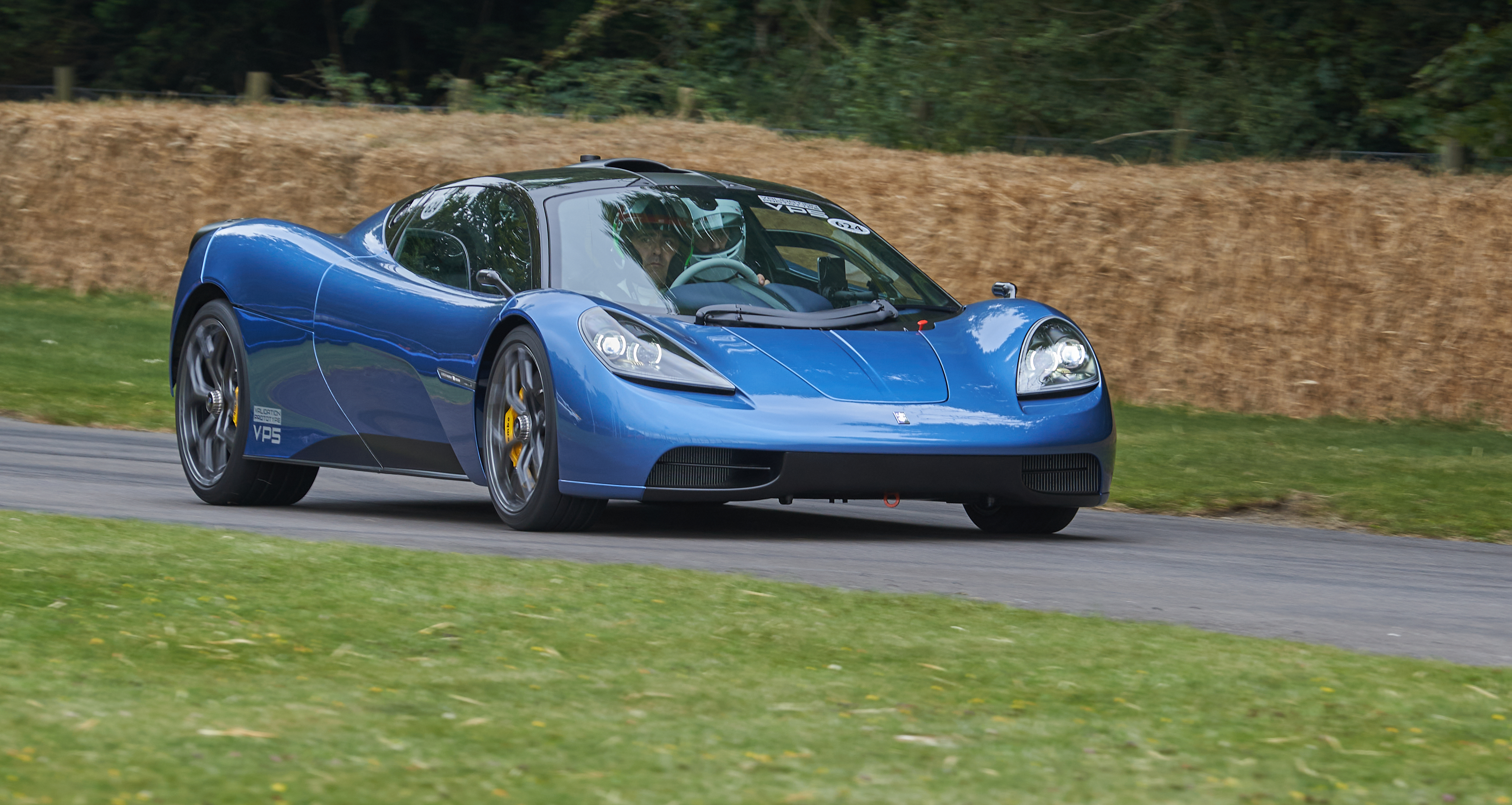
Gordon Murray T.50 Road Test: How It Compares to the F1
The Gordon Murray T.50 is in owners' hands in 2026 — its 661hp, fan-assisted V-12 draws direct comparisons to the McLaren F1 and its creator's legacy.
- The T.50 in Context: Gordon Murray's Return to the Centre Seat
- Technical Specs and What They Mean on the Road
- The Fan Car System: Racing Heritage in a Road Car
- How the T.50 Measures Up to the McLaren F1
- What the T.50's 2026 Auction Values Reveal
The Gordon Murray T.50 entered public life in August 2020 with its 100-car production run already sold out and the explicit promise of delivering "the world's greatest driver's car." In 2026, as UK owners put real miles on their cars and first driving impressions circulate, the comparison that dominates every conversation is the obvious one: how does the T.50 measure up against the McLaren F1 — the car that made Gordon Murray's name as a road car designer in the first place? Top Gear settled the question as early as 2023, awarding the T.50 its Hypercar of the Year prize and calling it "the best driver's car in the world." The driving accounts now emerging from owners suggest that verdict has only been reinforced.
The T.50 in Context: Gordon Murray's Return to the Centre Seat
The McLaren F1, produced from 1992 to 1998, defined a generation of supercar thinking: naturally aspirated engine, centre-mounted driver's seat, six-speed manual gearbox, obsessive weight reduction. It was designed to feel connected, immediate, and honest — qualities that were already becoming scarce as turbocharged powertrains and paddle-shift gearboxes standardised across the segment.
The T.50 is, in many respects, a deliberate act of defiance against that trajectory. Murray retained the centre-seat layout that made the F1 iconic, placed a naturally aspirated V-12 ahead of the driver, and paired it with a manual gearbox. The production run of just 100 cars — fully allocated before the car had even been seen by its future owners — indicates that Murray's audience was prepared to trust his philosophy before they'd had a chance to evaluate the result.
Technical Specs and What They Mean on the Road
The T.50's 3.9-litre Cosworth GMA V-12 produces 661 horsepower at 11,000 rpm, with a ceiling of 12,100 rpm. That redline figure deserves attention: most naturally aspirated V-12s in road applications are tuned to deliver torque across a broad mid-range band, making them tractable and usable at everyday speeds. The Cosworth unit is calibrated for the upper register of its rev range, which means it rewards — and requires — a driver who is prepared to work it hard. That characteristic defines the experience.
The dry weight is below 1,000 kg. That figure is what separates the T.50 from most contemporary rivals that have pursued similar power outputs through larger, turbocharged, or hybridised drivetrains. Additional electrification adds mass; the T.50 achieves its performance envelope without it. The result is a power-to-weight dynamic that translates into responsiveness and tactile feedback in ways that headline horsepower numbers alone cannot convey.
The six-speed manual gearbox is another deliberate editorial choice. Dual-clutch automatics dominate the hypercar segment because they are measurably faster on track. Murray chose not to use one — the gearbox is part of the car's argument, not an oversight.
The Fan Car System: Racing Heritage in a Road Car
The T.50's most technically singular feature is its 400mm rear-mounted fan, which actively increases underbody ground effect by 50 per cent. The concept is lifted directly from Murray's own 1977 Formula One Brabham BT46B — a design so aerodynamically effective it was withdrawn from competition after a single race.
In road car form, the fan performs downforce work without the usual visual apparatus: no oversized rear wing, no deep front splitter, no dramatic bodywork that announces its aerodynamic loading before the car has turned a wheel. The T.50's silhouette is unusually clean for a car generating serious aerodynamic grip. The fan operates largely invisibly, which is both an engineering achievement and a styling statement.
The practical consequence is a car that is track-capable on its aerodynamics while remaining visually restrained on public roads — a balance very few modern hypercars manage.
How the T.50 Measures Up to the McLaren F1
The McLaren F1 produced 618 horsepower from its BMW S70/2 V-12, weighed approximately 1,140 kg dry, and carried no active aerodynamic systems. Against those benchmarks, the T.50 is more powerful, lighter by roughly 140 kg, and aerodynamically far more sophisticated. On paper, the comparison is decisive.
The more meaningful measure, though, is philosophical. Both cars were designed around the same central thesis: minimise the gap between driver intention and vehicle response. Both use naturally aspirated V-12 engines, manual gearboxes, and centre-seat packaging. Both deprioritise outright acceleration in favour of tactile communication.
What separates them is access to three decades of engineering advancement. The Cosworth unit revs higher and produces more power without forced induction. The fan system delivers aerodynamic performance that was unavailable to Murray when the F1 was in development. The sub-1,000 kg target is achievable with composites and production techniques that simply did not exist in 1992.
The T.50 does not replicate the F1 — it extends its logic using every tool Murray did not have the first time.
What the T.50's 2026 Auction Values Reveal
In April 2026, Broad Arrow Auctions listed chassis 009 — a US-market T.50 showing just 27 delivery miles — at an estimate of $8 million to $10 million, marking the first North American public auction of the model. The car was originally part of a production run priced substantially below that level.
The appreciation reflects two converging signals: the structural scarcity of a 100-unit run, and the market's collective assessment that the T.50 has delivered on its promise. Cars that disappoint their owners do not appreciate at this rate. The T.50's position in the collector market is, in financial terms, a verdict on whether the driving experience matched the expectations set before anyone had turned a wheel.
Key Takeaways
- The T.50's Cosworth V-12 revs to 12,100 rpm and peaks at 11,000 rpm — calibrated for the top of its range, not a broad mid-range torque curve.
- Sub-1,000 kg dry weight gives the T.50 a power-to-weight dynamic that turbocharged rivals producing similar horsepower cannot match for driver engagement.
- The 400mm rear fan system, drawn from Murray's banned 1977 Brabham F1 design, generates active downforce without wings or splitters — keeping the car visually clean at road-car speeds.
- Centre-seat layout and manual gearbox are explicit continuations of McLaren F1 philosophy, deliberately rejecting the automated, turbocharged direction of the modern hypercar market.
- A T.50 chassis was estimated at $8–10 million at April 2026 auction, well above original pricing — a market signal that owner confidence in the delivered experience is strong.