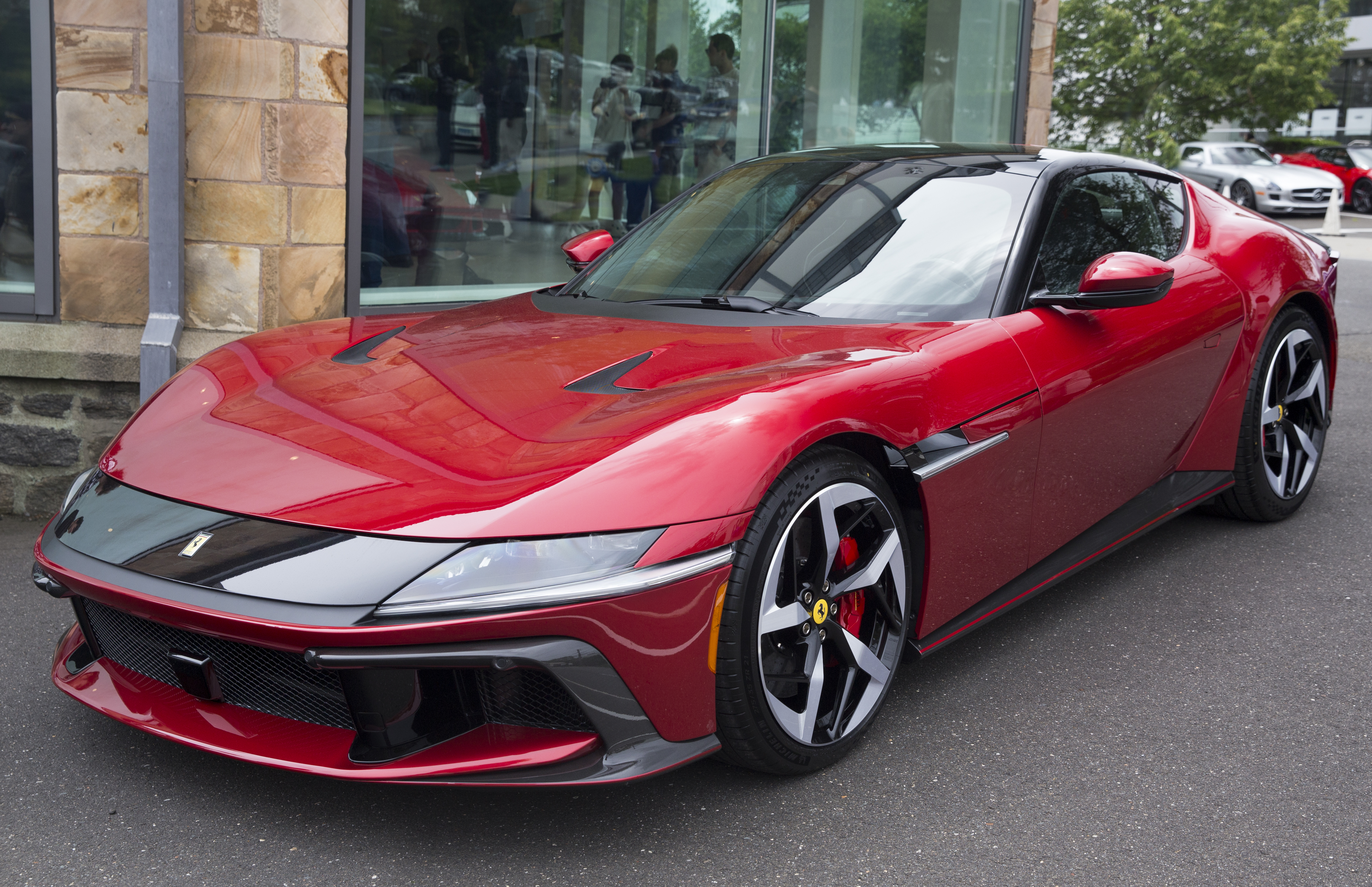
Ferrari 12Cilindri vs Aston Martin Vanquish: Which £330k GT Wins?
The two most compelling V12 grand tourers of 2025–26 go head-to-head on power, driving feel, cabin quality, and which better justifies its six-figure UK price.
- The Case for a V12 GT in 2026
- Engines and Performance
- Driving Feel: Calm Grand Tourer vs High-Strung Supercar
- Cabin, Build Quality, and Day-to-Day Liveability
- Residual Value and Rarity
- Which GT Justifies Its UK Price Premium?
- Key Takeaways
- Sources
The Ferrari 12Cilindri and Aston Martin Vanquish represent the last great stand of the naturally-aspirated and big-displacement V12 GT. Both makers resisted electrification and downsizing to produce halo cars that prioritise sound, sensation, and prestige — at prices that sit firmly north of £300,000.
A note on framing: the DB12, Aston's twin-turbo V8 coupe at roughly half the price, sits in a different competitive bracket. The true like-for-like rival to the Ferrari 12Cilindri in Aston's 2025–26 range is the third-generation Vanquish, priced from £334,000 and limited to 1,000 units per year.
The Case for a V12 GT in 2026
It is, by any rational measure, a strange time to be launching a V12. Emissions legislation has tightened, EV sales are accelerating, and the engineering cost of homologating a large-displacement combustion engine to global standards is eye-watering. Yet Aston Martin spent five years — including a Covid-related delay — developing an entirely new 5.2-litre twin-turbocharged V12 for the Vanquish. Ferrari, for its part, extended the life of its naturally-aspirated V12 with the suitably named 12 Cilindri.
The market has responded. Both cars attract buyers willing to pay for something irreplaceable: the sound, the occasion, the sense that this configuration of engine and grand touring ambition may not exist a decade from now.
Engines and Performance
The Vanquish's new V12 is the more powerful unit. With revised cylinder heads, reprofiled camshafts, a higher-pressure injection system, and lower-inertia turbos with faster spool-up, it produces 824bhp and 737lb ft of torque from 2,500rpm — figures that comfortably surpass the naturally-aspirated Ferrari 12Cilindri on both headline power and low-down shove.
The resulting performance is extraordinary: 0–62mph in 3.3 seconds and a top speed of 214mph, all delivered through an eight-speed ZF automatic. A "boost reserve" system pre-builds turbo pressure on part-throttle, eliminating the hesitation that can blunt a forced-induction GT and making throttle response feel closer to a naturally-aspirated unit.
The Ferrari counters with its atmo V12's more linear character and higher-revving nature — qualities that enthusiasts prize regardless of peak output. What the Vanquish has over the Ferrari on pure numbers, the 12Cilindri reclaims in the way the power is delivered.
Driving Feel: Calm Grand Tourer vs High-Strung Supercar
This is where the two cars diverge most clearly in character. The Vanquish, according to evo's Senior Staff Writer Yousuf Ashraf, "fulfils its GT role really well. It carries speed effortlessly, there's enormous reserves of power and torque. It's such a different character to a 12 Cilindri, less highly strung and calmer, less reactive."
That measured quality comes through in the dynamics. The Vanquish uses double wishbones up front and multi-link at the rear, with Bilstein DTX adaptive dampers tuned for what Aston describes as "supple secondary ride and strong primary control." A new electronic differential — the first on a V12 Aston Martin — allows variable locking in milliseconds, sharpening both agility and traction without the abruptness of a mechanical locker.
The steering builds confidence quickly. On a winding road the Vanquish finds a satisfying rhythm: accurate at the front, well-balanced overall, more measured in its responses than previous Astons. It is not a car that demands your full attention at all times — which is precisely what a GT should offer.
The Ferrari 12Cilindri plays a different game. Its naturally-aspirated V12 rewards rev-chasing and delivers a more theatrical, reactive experience. Where the Vanquish settles you into effortless progress, the Ferrari keeps you engaged, even alert. Neither approach is wrong; they serve different versions of the same customer.
One genuine weakness for the Vanquish: road noise intrudes more than its price suggests, particularly on coarser British surfaces — a consideration for motorway GT work. The 21-inch Pirelli P Zeros include Pirelli's foam-based Noise Cancelling System, but some tyre roar persists.
Cabin, Build Quality, and Day-to-Day Liveability
The Vanquish brings wholesale interior updates over the DBS Superleggera it replaces. Unstressed body panels are now carbonfibre rather than pressed aluminium, saving 40 per cent in material weight and giving the cabin structure a more exotic feel. Visible carbon on the roof, the rear 'shield' panel, mirrors, and aerodynamic addenda signal the car's flagship status without tipping into vulgarity.
Space, however, is limited — the Vanquish is not designed for families or long-haul comfort with rear passengers. The stretched wheelbase (the chassis is 80mm longer between the A-pillar and front axle) improves proportions and slightly aids front occupant space, but this remains a strict two-plus-occasional-two.
The Ferrari 12Cilindri's cabin similarly prioritises the driver's environment. Both cars reflect their makers' current interior philosophies: Aston's is more classically British in its leather and metal detailing; Ferrari's leans into technical precision and motorsport reference.
Residual Value and Rarity
Limited production is the Vanquish's strongest residual argument. With Aston Martin committing to a cap of no more than 1,000 cars per year, scarcity is engineered into the model. Combined with the approaching end of new V12 GT production at this price point — the engineering cost of re-homologating such an engine a second time is prohibitive — the Vanquish has credible long-term value credentials.
The Ferrari 12Cilindri carries the Prancing Horse's historically stronger residual reputation. Ferrari's production discipline and brand equity have consistently supported values on limited-volume V12 models. Both cars are likely to depreciate less steeply than mainstream alternatives, though exact trajectories depend on the pace of combustion engine regulation across key markets.
Which GT Justifies Its UK Price Premium?
At £334,000, the Vanquish demands justification. The case for it rests on three things: 824bhp that no comparable front-engined GT can match, a driving character that is simultaneously exploitable and relaxing, and a level of exclusivity the manufacturer has formally committed to preserving.
The Ferrari 12Cilindri asks a similar sum for a more naturally aspirated, higher-revving experience with arguably superior brand cachet and residual track record. If naturally-aspirated purity matters to you, the Ferrari is the right answer. If you want more power, more torque, and a GT that will carry you across a continent at effortless pace while still rewarding a fast road, the Vanquish makes a compelling — and increasingly rare — case.
For buyers weighing up the Aston Martin DB12 as an entry point to this segment, it's worth noting that the DB12 established the driver-centric philosophy the Vanquish now executes at higher intensity. It is a different proposition entirely in price and character, not a direct substitute.
Key Takeaways
- The Aston Martin Vanquish (£334,000) is the direct UK rival to the Ferrari 12Cilindri, not the DB12, which sits in a different price bracket.
- Vanquish leads on power: 824bhp and 737lb ft versus a less powerful naturally-aspirated Ferrari V12.
- Ferrari 12Cilindri counters with naturally-aspirated linearity, higher-revving character, and historically stronger residuals.
- The Vanquish suits buyers who want a calmer, more effortless GT experience; the Ferrari rewards those who want to stay more engaged.
- Both cars are limited-production V12 flagships unlikely to have direct successors — rarity strengthens the case for either as a long-term hold.
Sources
evo.co.uk — Aston Martin Vanquish review – Britain's Ferrari 12 Cilindri rival (26 Jan 2026)