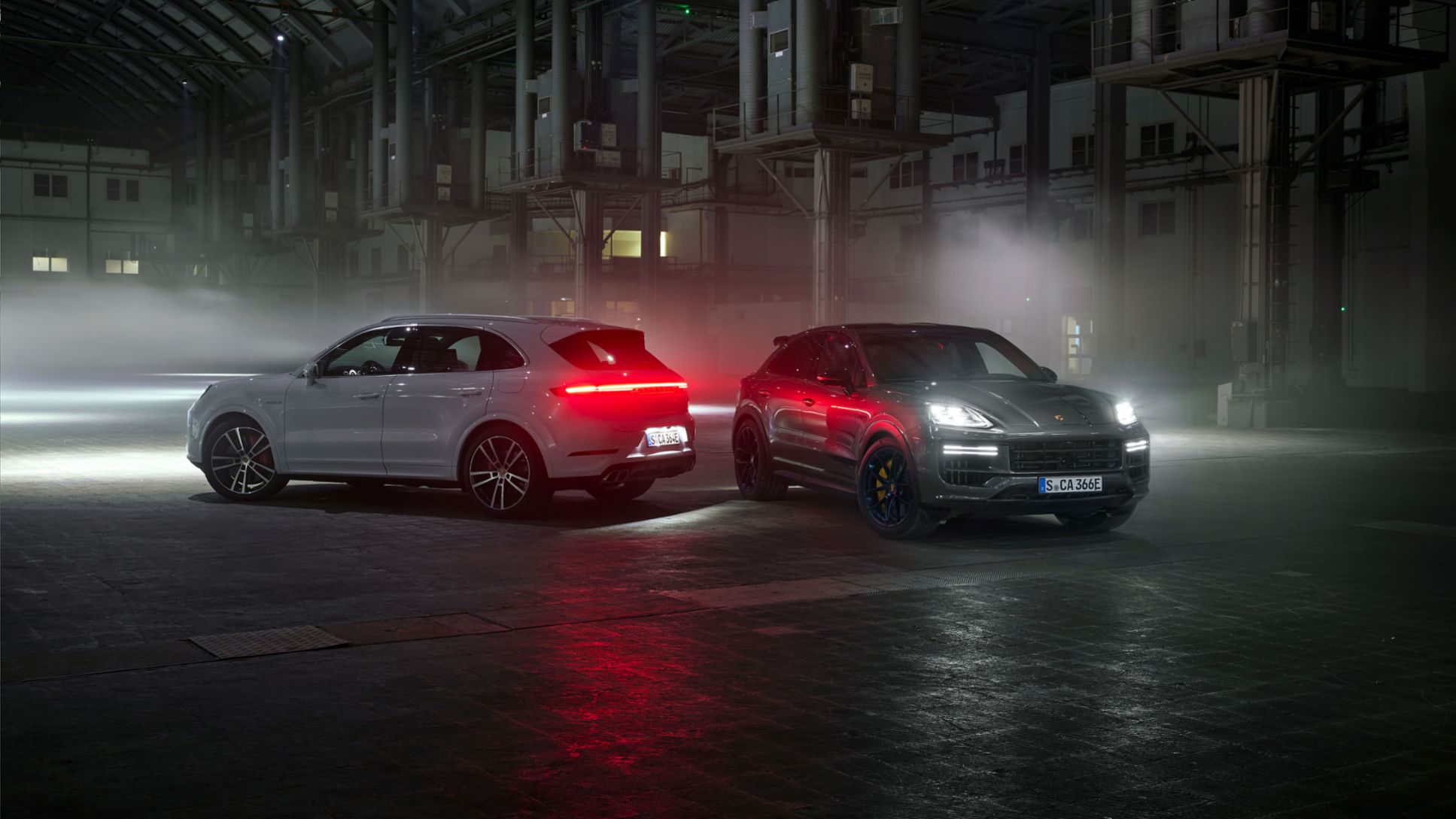
Cayenne Turbo E-Hybrid vs Bentayga Azure: 2026 Value Test
The Porsche Cayenne Turbo E-Hybrid and Bentley Bentayga Azure are the UK's most talked-about luxury hybrid SUVs — but which delivers better real-world value when running costs and residuals enter the equation?
- Two Very Different Approaches to Hybrid Luxury
- Power and Performance: What the Numbers Show
- Battery Size and Electric Running Potential
- Purchase Price and the Value Gap
- Real-World Running Costs: What Buyers Should Know
- Five-Year Residual Outlook
- Key Takeaways
- Sources
The Porsche Cayenne Turbo E-Hybrid and the Bentley Bentayga Azure represent the twin peaks of the luxury hybrid SUV market in the UK. Both promise to combine electrified efficiency with serious performance, and both carry price tags that demand scrutiny. The question for 2026 buyers is no longer which feels more desirable on a test drive — it's which one makes financial sense over five years of ownership.
Two Very Different Approaches to Hybrid Luxury
These two cars take philosophically distinct routes to the same destination. Porsche's Cayenne Turbo E-Hybrid sits at the very top of the Cayenne range and is built around a performance-first brief: a twin-turbocharged 4.0-litre V-8 combustion engine working alongside two electric motors and a 21.8 kWh battery pack. It is, in essence, a sports car that happens to have five seats and a tailgate.
Bentley's approach with the Bentayga Azure is softer in character. The Azure trim is the luxury-oriented tier in the Bentayga range, and its electrified variant pairs a twin-turbocharged 3.0-litre V-6 with a plug-in hybrid system. Where Porsche optimises for lateral g-forces, Bentley optimises for waftability — the silky power delivery that has long defined the brand's identity.
Power and Performance: What the Numbers Show
The power gap between the two cars is substantial. According to Road & Track's hybrid SUV rankings, the Cayenne Turbo E-Hybrid produces 729 hp and a substantial 700 lb-ft of torque, enabling a 0–60 mph sprint of 3.5 seconds. That places it third among the world's most powerful hybrid SUVs, behind only the Lamborghini Urus SE and the BMW XM Label.
The Bentayga Hybrid, by contrast, produces 456 hp and 516 lb-ft of torque. That still delivers effortless highway performance, but it is a different proposition entirely — closer to a refined grand tourer than a thinly disguised track weapon. For buyers who will never use 700 hp on a public road, the Bentley's more measured output may represent a more honest purchase.
Battery Size and Electric Running Potential
The Cayenne's 21.8 kWh battery pack is one of the larger units in the premium PHEV segment. In real-world UK use — factoring in heating loads, speed variation on motorways, and the inevitable discharge curves that WLTP figures tend to obscure — owners can expect somewhere in the range of 25–35 miles of genuine electric-only running in mixed conditions, though Porsche's official WLTP electric range will be higher.
Bentley does not publish the battery capacity of the Bentayga Hybrid in the same detail, which makes like-for-like comparison harder. What Road & Track's data confirms is that the Azure Hybrid uses a turbocharged 3.0-litre V-6 as its combustion partner, a smaller and lighter unit than the Cayenne's V-8, which has implications for fuel consumption once the battery is depleted.
For company car drivers using HMRC's benefit-in-kind framework, the electric range figure is the critical variable — a higher WLTP electric range directly reduces the BIK percentage band, which can be worth thousands of pounds annually depending on the driver's tax bracket.
Purchase Price and the Value Gap
In the United States, the Cayenne Turbo E-Hybrid carries a list price of $161,050, while the Bentayga Hybrid lists at $242,050 — a gap of over $80,000. UK pricing follows a different structure, with VAT, import duties, and options packages all affecting the final figure, but the relative positioning between the two models is consistent: the Porsche offers considerably more horsepower at a meaningfully lower price point.
For buyers focused on value, that differential is significant. The Cayenne delivers 273 more horsepower than the Bentayga Hybrid for a lower outlay. Whether that matters depends entirely on what the buyer is optimising for: performance per pound favours Porsche decisively, while brand prestige and interior grandeur may still tilt some buyers toward the Bentley.
Real-World Running Costs: What Buyers Should Know
Both cars are plug-in hybrids, so running costs split into two distinct scenarios: predominantly electric use (short urban journeys, regular home charging) and predominantly combustion use (long motorway runs with a depleted battery).
In the first scenario, the PHEVs deliver genuinely low pence-per-mile costs comparable to a fully electric vehicle for covered distance. In the second, the picture reverses sharply. A twin-turbo V-8 with a depleted battery is not an economical motorway cruiser. The Cayenne's V-8 will consume fuel at a rate that erases any efficiency advantage if buyers fail to charge regularly — a pattern that real-world studies of PHEV usage have consistently documented.
The Bentayga's V-6 hybrid is marginally better positioned for undischarged running given the smaller engine, but neither car should be purchased primarily on the strength of its official fuel economy figures.
Five-Year Residual Outlook
Residual values in the luxury SUV sector are driven by three factors: brand strength, trim complexity, and the pace of electrification legislation. Porsche historically holds residuals well — the Cayenne nameplate has strong used-market demand — and the Turbo E-Hybrid's position at the top of the range supports that. Bentley residuals are influenced by the brand's relative exclusivity and lower production volumes.
However, both cars face the same structural risk: PHEV technology is transitioning. Battery degradation, evolving charging infrastructure, and the expectation of fully electric successors mean that five-year-old PHEVs in the £100,000-plus segment face more residual uncertainty than equivalent combustion models. Buyers should seek current cap HPI projections before committing.
Key Takeaways
- The Cayenne Turbo E-Hybrid produces 729 hp and costs significantly less than the Bentayga Azure Hybrid's 456 hp package — performance-per-pound favours Porsche by a wide margin.
- The Cayenne's 21.8 kWh battery is among the larger PHEV units in the segment, supporting stronger real-world electric range and better BIK tax positioning for company car drivers.
- Both cars carry significant fuel consumption risk if driven long distances on a depleted battery; the Bentayga's V-6 has a marginal advantage over the Cayenne's V-8 in that scenario.
- Purchase price differences of £60,000–£80,000 (estimated UK equivalent) represent a meaningful residual and depreciation variable that five-year cost-of-ownership calculations must account for.
- PHEV residual values across the luxury segment face structural uncertainty as the market transitions toward full electrification — current cap HPI data should be reviewed before purchase.
Sources
Road & Track — Most Powerful Hybrid SUVs for 2025 (August 13, 2025)