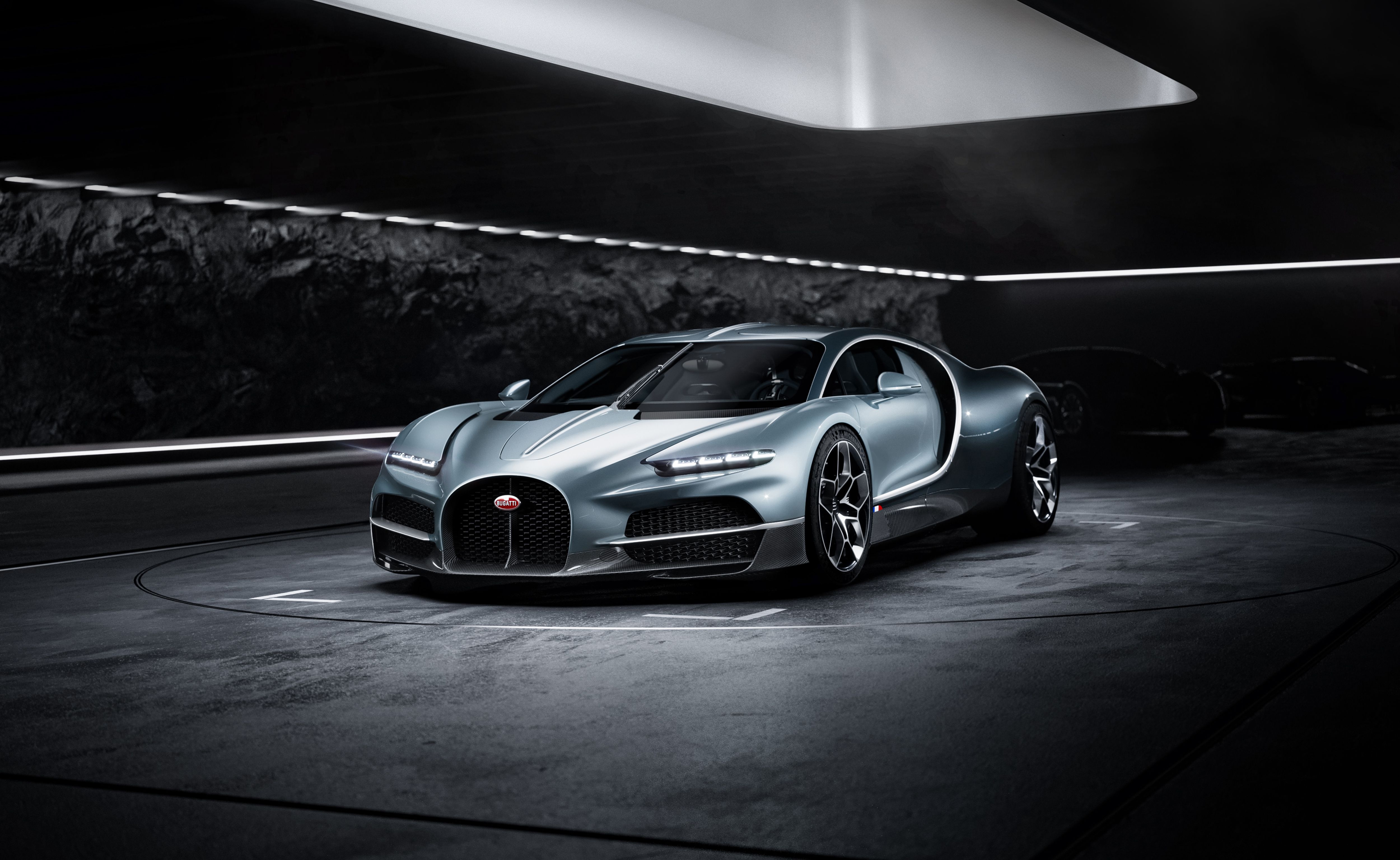
Bugatti Tourbillon UK Price, Specs and What It Means for the Brand
The £3.2 million Bugatti Tourbillon swaps the Chiron's legendary W16 for a screaming V16 hybrid — here's what that shift tells us about where Bugatti is heading.
- A New Formula for Ultra-Hypercars
- The Powertrain: V16 Meets Rimac Electric Motors
- UK Price and What £3.2 Million Buys You
- Performance Figures: How Fast Is the Tourbillon?
- What the Tourbillon Signals for Bugatti's Future
- Key Takeaways
- Sources
A New Formula for Ultra-Hypercars
The Bugatti Tourbillon is not a modest evolution of what came before. It replaces the Chiron — a car built around one of the most celebrated combustion engines ever fitted to a road car — and in doing so marks a clean break from the formula that made Bugatti synonymous with the quad-turbo W16. That engine is gone. In its place sits a naturally aspirated V16, augmented by three Rimac-sourced electric motors in a plug-in hybrid configuration.
For the ultra-hypercar segment, the Tourbillon's arrival represents a watershed moment. It signals that even at the very apex of performance motoring, the internal combustion engine alone is no longer considered sufficient. The question now is not whether electrification will come to this tier of the market — it already has — but how manufacturers choose to blend the two technologies without sacrificing the sensory theatre that justifies the price tags.
The Powertrain: V16 Meets Rimac Electric Motors
The decision to abandon the W16 is significant in itself. That engine — turbocharged, 16-cylinder, positioned transversely — was Bugatti's technical signature across the Veyron and Chiron eras. The V16 that replaces it in the Tourbillon is naturally aspirated, which marks a philosophical shift: instead of forced induction generating headline power figures, the new engine revs freely and produces 986bhp on its own.
That figure places the V16 among the most powerful naturally aspirated engines ever installed in a production car, yet it tells only part of the story. Three electric motors sourced from Rimac — the Croatian EV hypercar company that forms part of the Bugatti Rimac joint venture — supplement the V16 to produce a combined system output of 1,775bhp. The result is a plug-in hybrid that weighs approximately two tonnes yet moves with the urgency you'd expect from something producing nearly twice the power of a Lamborghini Huracán.
The Rimac connection matters beyond the hardware. Mate Rimac's company has become the engineering partner shaping Bugatti's technical direction, and the Tourbillon's powertrain architecture reflects that partnership at its most ambitious.
UK Price and What £3.2 Million Buys You
In the UK, the Bugatti Tourbillon is priced at £3.2 million. That positions it at the very top of the road-legal production car market — comfortably above even the Rimac Nevera, and comparable only to a handful of bespoke commissions from coachbuilders and ultra-low-volume manufacturers.
For context, that figure is buying you:
- A hand-assembled naturally aspirated V16 engine producing 986bhp
- Three additional Rimac electric motors for a combined 1,775bhp
- A sub-two-second 0–60mph capability, despite a two-tonne kerb weight
- Bugatti's claim that the Tourbillon is "right up there" among the world's fastest cars by top speed
- Access to one of the most technically complex road-car powertrains ever engineered
Allocation details have not been made fully public, and demand among Bugatti's established customer network is expected to far exceed supply — as has been the case with every limited Bugatti model since the Veyron. Prospective buyers typically approach through Bugatti's dealer network and are assessed against prior purchasing history with the brand.
Performance Figures: How Fast Is the Tourbillon?
The Tourbillon sits sixth in a ranking of the world's fastest-accelerating production cars currently on sale, which gives useful perspective. Despite 1,775bhp, it falls short of the top five on 0–60mph time — underscoring just how competitive the ultra-hypercar and high-performance EV segment has become.
Key figures, as claimed by Bugatti:
- 0–60mph: under 2.0 seconds
- 0–124mph: approximately 5.0 seconds
- Top speed: among the highest of any current production car
The 0–124mph figure is particularly telling. Getting a two-tonne car to 124mph in five seconds requires not just peak power but an ability to sustain massive thrust across a wide rev range — precisely the area where combining a high-revving naturally aspirated V16 with instant electric torque makes most sense.
What the Tourbillon Signals for Bugatti's Future
The Tourbillon's hybrid architecture raises a question that the company has not definitively answered: is this the last Bugatti built around a combustion engine as its primary propulsion source, or the first of a new formula that keeps combustion alive alongside electrification?
What is clear is that the pure combustion era is over at Bugatti. The Chiron's W16 existed in a world where electrification was optional at this price point. The Tourbillon exists in a world where even Bugatti — a brand whose entire identity was built on extreme combustion engineering — has concluded that electric motors are necessary to remain competitive on both performance and regulatory grounds.
Whether a future Bugatti goes fully electric, as Rimac's own Nevera is, remains to be seen. The Tourbillon's V16 screams in a way that no EV can replicate, and Bugatti knows its customers value that sensory dimension highly. But the direction of travel is unmistakable: combustion will shrink in its role even if it doesn't disappear entirely from Molsheim's lineup in the near term.
For the ultra-hypercar segment as a whole, the Tourbillon is a reference point. If Bugatti — with its century of combustion heritage — has moved to hybrid, every rival at this price level is navigating the same inflection point.
Key Takeaways
- The Bugatti Tourbillon costs £3.2 million in the UK and replaces the Chiron as Bugatti's flagship model.
- It abandons the quad-turbo W16 in favour of a naturally aspirated V16 producing 986bhp, paired with three Rimac-sourced electric motors for a combined 1,775bhp.
- Despite weighing two tonnes, the Tourbillon claims a 0–60mph time of under two seconds and 0–124mph in approximately five seconds.
- The hybrid architecture marks a clear shift: combustion alone is no longer Bugatti's formula, even at the pinnacle of the market.
- Allocation is expected to be extremely limited and managed through Bugatti's established customer network.
Sources
RAC — Fastest cars in the world 2026: Top 10 (5 January 2026)